


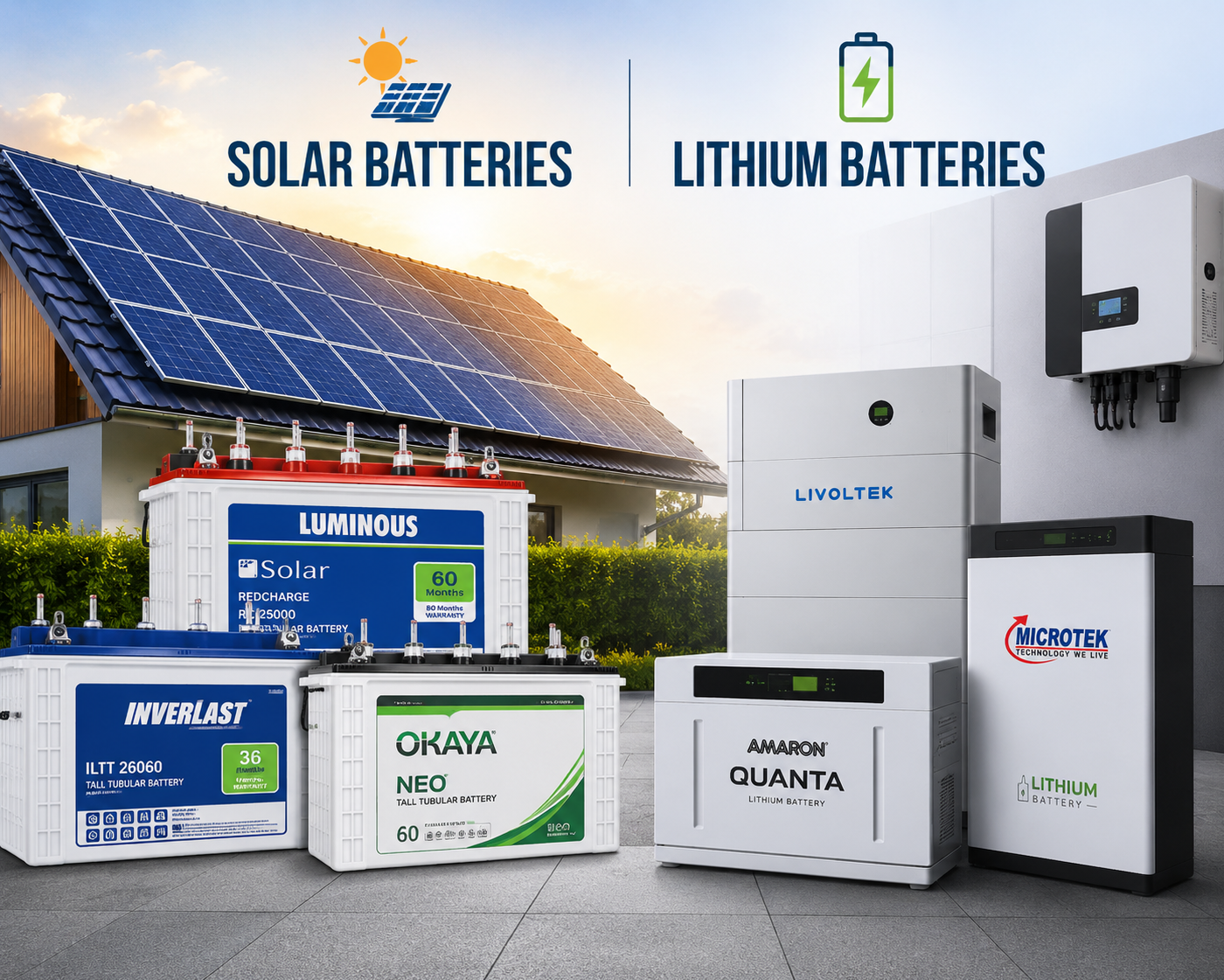
Battery storage becomes important when a solar system needs to provide electricity beyond daylight generation or support selected loads during grid interruptions. However, choosing a battery should involve more than comparing storage capacity and price.
Conventional battery technologies and lithium batteries differ in usable capacity, cycle life, maintenance, charging characteristics, weight, and upfront cost.
Why Add Batteries to Solar?
An on-grid solar installation does not necessarily require batteries. Storage becomes relevant when the system is designed for backup, off-grid operation, or greater control over when solar-generated electricity is used.
A battery stores electrical energy that can later be supplied to connected loads according to the system configuration.
Conventional Batteries
Traditional battery technologies have long been used with inverter and solar applications.
Depending on the specific technology, they can offer a lower initial purchase cost. However, users should consider usable depth of discharge, maintenance requirements, charging time, installation space, ventilation needs, and expected cycle life.
A battery that appears inexpensive initially may have different lifecycle economics once replacement frequency and usable energy are considered.
Lithium Batteries
Lithium-based batteries have become increasingly relevant for modern solar storage.
Potential advantages, depending on the battery design, include:
- Higher usable depth of discharge
- Longer cycle life
- Faster charging capability
- Compact physical size
- Lower weight
- Reduced routine maintenance
- Integrated battery management features
The higher initial cost means the decision should still be based on application requirements rather than automatically assuming lithium is necessary.
Compare Usable Energy, Not Just Rated Capacity
Battery labels can be misleading when compared without understanding how much stored energy can practically be used.
Two batteries with similar nominal capacities may offer different usable energy depending on their recommended depth of discharge.
The load requirement also matters. Running lights and fans during an outage is very different from attempting to support air-conditioning, pumps, machinery, or other high-power equipment.
Compatibility Is Essential
A battery should be compatible with the inverter and overall electrical design.
Voltage, charging parameters, discharge current, communication requirements, protection systems, and battery management settings need to align correctly.
This is particularly important for lithium battery systems.
What Works for Nagpur Users?
For homes and businesses in Nagpur, battery selection should begin with a backup-load assessment.
Identify which equipment genuinely needs uninterrupted supply, how many hours of backup are required, and whether grid outages are frequent enough to justify additional storage investment.
A properly sized battery system can add significant functionality to solar. Oversizing, however, increases project cost unnecessarily, while undersizing can produce disappointing backup performance.
The practical choice is therefore not simply conventional versus lithium. It is the battery technology and capacity that best matches the property's required backup duration, load profile, budget, and expected frequency of use.